

Pest Library
Asian Subterranean Termite
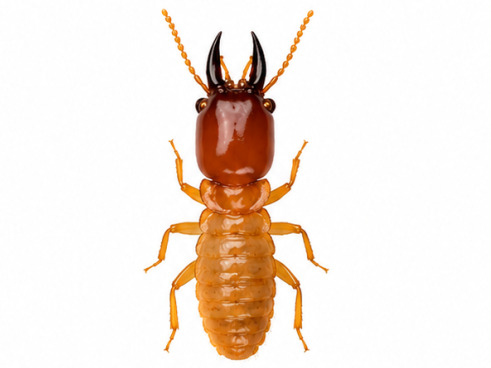
Asian Subterranean Termite Quick Facts
Size:
Swarmers are roughly 1/2 inch long including wings, while workers and soldiers are smaller, around 1/4 inch long.
Color:
Swarmers are dark brown to blackish, whereas workers and soldiers are cream-colored with light brown heads.
How to identify:
Look for swarming winged adults with two pairs of equal-sized wings, straight antennae, and soldiers with smooth oval heads that lack teeth on their teardrop-shaped mandibles.
Active season:
Swarming typically peaks in South Florida during late winter through spring (February to May), though colony activity underground continues year-round.
Indoor or outdoor:
Operates primarily underground and within damp soil, but will readily construct shelter tubes to forage inside homes, commercial structures, and living trees.
Day or night:
Swarmers are mostly active at night, frequently taking flight in large numbers at dusk or early evening while drawn toward exterior lights and window illumination.
Diet:
Cellulose-based materials, primarily softwoods, structural timber, paper, cardboard, landscape mulch, and living woody plants.
About Asian Subterranean Termites
Asian Subterranean Termites vs. Formosan Subterranean Termites
South Florida is one of the few regions in the world where the ranges of the Asian subterranean termite (Coptotermes gestroi) and Formosan subterranean termite (Coptotermes formosanus) overlap. While both invasive species belong to the same genus and cause significant structural damage, key differences exist:
Swarming Schedule: Asian subterranean termites typically swarm earlier in the year, starting as early as February, whereas Formosan termites usually peak later in spring (May and June).
Coloration: Asian swarming adults generally feature a darker brown body color compared to the lighter, yellowish-brown appearance of Formosan swarmers.
Hairs on Wings: Under magnification, Asian subterranean termite wings feature fine microscopic hairs, helping professional entomologists distinguish between species.
Why DIY Asian Subterranean Termite Control Fails
Managing an Asian subterranean termite infestation requires specialized techniques. Store-bought products and do-it-yourself attempts rarely achieve complete colony elimination for several key reasons:
Lower-Impact Options
Where appropriate, Pest Busterzz prioritizes perimeter baiting stations and non-repellent treatments directly where termites forage to eliminate nests while minimizing unnecessary chemical use inside your home.
The Pest Busterzz Asian Subterranean Termite Treatment Approach
Pest Busterzz delivers comprehensive subterranean termite management solutions tailored to the unique construction styles and environmental conditions of South Florida properties.
Inspection
We evaluate foundation lines, crawl spaces, plumbing penetrations, and surrounding landscape features to identify active mud tubes, hollowed wood, and environmental moisture sources supporting colony growth.
Targeted Treatment
Treatment plans are customized based on inspection findings. Strategies may include installing monitored baiting systems around the foundation or applying non-repellent termiticides that foraging workers carry back to eliminate the central underground colony.
Monitoring & Follow-Up
We routinely monitor installed baiting stations, evaluate ongoing activity levels, and verify that exterior protective barriers remain effective against surrounding neighborhood pressure.
Prevention
Our team provides actionable property tips, such as eliminating wood-to-soil contact, pulling mulch back from foundations, diverting air conditioner condensation drip lines, and sealing slab penetrations.
faqs