
Is Trapping Mice Enough, or Do You Need Full Rodent Control in South Florida?
Trapping mice can remove rodents that are already inside your South Florida home, but trapping alone usually does not address how they entered or what is attracting them. Full rodent control combines removal with inspection, exclusion, sanitation recommendations, and prevention. For lasting control, the goal is not simply to catch mice, but to stop new rodents from getting inside.
At Pest Busterzz, we understand how unsettling it is to hear scratching in a wall, discover droppings in a cabinet, or realize something has been getting into stored food. Our approach to mice pest control focuses on solving the larger problem rather than simply reacting to the mouse you happened to see. South Florida homes face year-round pest pressure, and rodents can exploit surprisingly small openings around roofs, doors, utility lines, garages, and other vulnerable areas. Pest Busterzz helps homeowners identify signs of activity, locate potential access points, address existing rodents, and build a strategy designed to reduce the chance of another infestation.
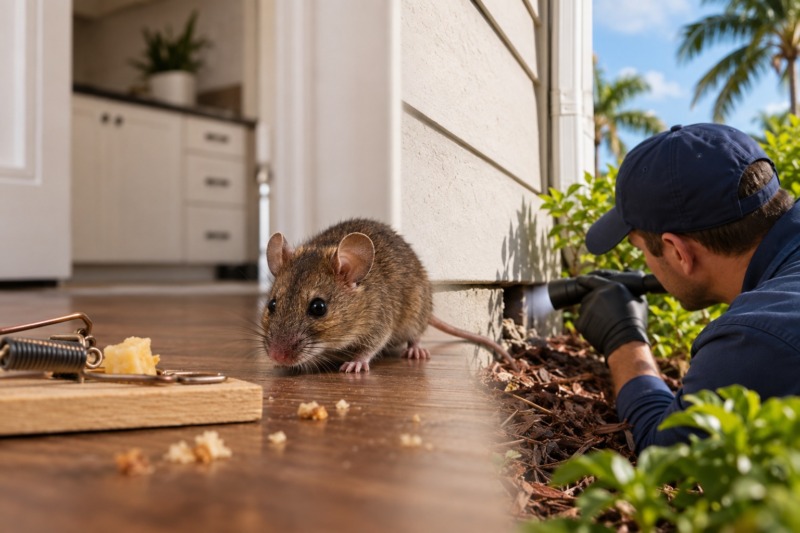
Why Professional Mice Pest Control Goes Beyond Setting Traps
A mouse trap is a removal tool. Rodent control is a strategy.
That distinction matters because catching one or several mice does not necessarily mean the infestation is over. The Centers for Disease Control and Prevention (CDC) recommends both trapping rodents and inspecting the home to determine how they entered. The CDC also advises sealing openings to help prevent new infestations.
What Is the Difference Between Mouse Trapping and Full Rodent Control?
Mouse trapping focuses on the rodents currently inside. Full rodent control addresses both the rodents and the conditions allowing the infestation to continue.
A comprehensive rodent control plan may involve:
- Inspecting the interior and exterior for rodent activity
- Identifying likely entry and travel points
- Strategically placing appropriate traps
- Sealing or recommending repairs to vulnerable openings
- Reducing access to food, water, and shelter
- Monitoring for continued activity
- Adjusting the control strategy when signs persist
This approach closely follows integrated pest management principles. The U.S. Environmental Protection Agency (EPA) describes Integrated Pest Management as combining preventive measures with treatment methods, including removing pest access to food, water, and shelter.
Simply setting a trap under the kitchen sink addresses only one part of that equation.
Why Do Mice Keep Coming Back After You Trap Them?
Mice can return when the openings that allowed them inside remain accessible. Even successful trapping does not prevent another mouse from following the same route into the structure.
The size of those openings can surprise homeowners. According to the CDC, mice can squeeze through a hole approximately 1/4 inch, or 6 millimeters, wide, roughly the width of a pencil.
Potential entry points include:
- Gaps around plumbing and utility penetrations
- Openings around doors and windows
- Roof, eave, soffit, and gable gaps
- Attic and crawl-space vents
- Openings around electrical, cable, and gas lines
- Structural gaps near foundations
This is why rodent exclusion is such an important part of long-term mice control. If an opening stays available, trapping can become a repeating cycle instead of a permanent solution.
What Makes Rodent Control Especially Important in South Florida?
South Florida properties provide rodents with abundant opportunities to find food, water, vegetation, and shelter, so prevention should extend beyond the room where mice are discovered.
UF/IFAS Extension recommends addressing leaks and standing water, sealing openings with rodent-resistant materials, removing yard clutter, and maintaining vegetation around Florida homes. It also notes the importance of repairing storm-related structural damage that could create new entry opportunities.
For South Florida homeowners, that means checking more than kitchen cabinets. Garages, attics, rooflines, utility penetrations, landscaping, storage areas, and exterior doors can all be relevant.
Storms deserve particular attention, too. The CDC notes that after natural disasters, rodents may move into new areas while searching for food, water, and shelter.
A post-storm inspection can therefore be valuable when a home has sustained roof, soffit, vent, door, or exterior damage.
How Does a Full Rodent Control Service Solve the Root Problem?
Effective rodent control works through removal, exclusion, prevention, and monitoring rather than relying on a single tactic.
A typical strategy follows four priorities:
- Find the activity. Droppings, gnaw marks, nesting material, noises, damaged food packages, and stale odors can indicate rodents. The EPA recommends looking for these signs even when you have never actually seen a mouse.
- Remove existing rodents. Properly positioned traps can reduce the active population. The CDC recommends traditional snap traps for household rodent control and advises continuing trapping until activity has stopped.
- Block entry points. Vulnerable holes and gaps should be sealed with materials appropriate to the opening. Exclusion helps prevent replacement rodents from entering after the original mice have been removed.
- Reduce attractants. Food should be stored securely, garbage containers should have tight-fitting lids, pet food should not remain accessible overnight, and leaks or other water sources should be corrected. These steps make the property less inviting to rodents.
Together, these measures turn mouse removal into actual rodent management.
When Should You Call a Professional Instead of Setting More Traps?
Professional mice pest control is worth considering when activity continues, rodents appear in difficult-to-access areas, or you cannot determine where they are entering.
Repeated droppings after cleanup are especially useful evidence. The CDC explains that if droppings reappear after an area has been safely cleaned, that indicates active rodent presence.
Other reasons to request an inspection include persistent scratching in walls or ceilings, recurring food damage, nesting material, multiple sightings, or activity that returns after DIY trapping.
There is also a health and sanitation component. Rodents can contaminate areas with urine, droppings, and saliva, and the CDC advises specific precautions for cleaning rodent-contaminated areas.
Frequently Asked Questions About Mice Pest Control
Does catching one mouse mean the problem is solved?
No. Catching a mouse confirms that the trap worked, but it does not prove that no other mice are present or that the entry point has been closed. Continue watching for fresh droppings, noises, gnaw marks, or other activity.
Can mice really get through tiny holes?
Yes. The CDC states that mice can fit through openings about 1/4 inch wide. That makes careful inspection and rodent exclusion important parts of long-term control.
Should I use traps or rodent bait?
The appropriate method depends on the location and severity of the infestation. The CDC recommends traditional snap traps for reducing rodents around homes and says poison or bait stations should be considered for persistent infestations, with products used according to their instructions and kept away from children and pets.
How can I help prevent mice from returning?
Seal accessible openings, store food securely, keep garbage covered, avoid leaving pet food out overnight, repair leaks, reduce exterior clutter, and monitor previously affected areas. Prevention works best when removal and exclusion are handled together.
Ready for Complete Mice and Rodent Control in South Florida?
A trap can catch a mouse. A complete rodent control strategy is designed to address why mice are getting inside and help keep the problem from starting over.
If you are finding droppings, hearing scratching, seeing mice, or repeatedly setting traps without solving the problem, contact Pest Busterzz today for professional mice pest control and rodent control in South Florida.